
Look, up in the sky! It’s neither a bird nor a plane, it’s a drone and
it’s heading rapidly your way. Unmanned aerial vehicles (UAVs) and their
Earth-bound driverless counterparts are fast becoming ubiquitous as the
technology gets smarter, safer, and less expensive.
Early-adopting technology geeks are not the only driver of the global UAV market’s rapid growth. According to research firm Markets and Markets,
annual sales will soar by 32% over the next five years to $5.59 billion
by 2020. Novel, high-end applications for drones and other driverless
vehicles in law enforcement, the military, precision agriculture, and
retail are flourishing in addition to an enthusiastic base of mainstream
consumers eager for drones to do their bidding.
As drone technology advances, engineers are pushing its boundaries to
explore unconventional, even slightly weird, applications for drones. Below are five examples from the extreme edge of the drone zone.
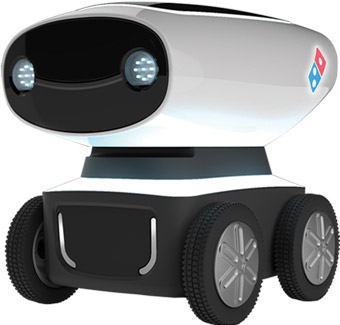
DRU, an autonomous pizza delivery vehicle. Image: Domino’s Robotic Unit
Pies in the Sky
When you’re expected to deliver a million pizzas a day in 30 minutes or
less, you’re always on the lookout for more efficient ways to do it.
Domino’s, the nation’s largest dough-thrower, has been testing high-tech
delivery systems
for years, including driverless technologies that so far have delivered
more publicity than pizza. But the global chain’s investment in
automation is part of a long-term strategy for growth within the tight
profit margins of the fast food industry. The chain’s United Kingdom
operation has explored several creative approaches to delivery
automation – often taking playful license with the Domino’s brand. The
remote-controlled DomiCopter,
for example, buzzes above congested city streets with a payload of
thermally insulated pizzas dangling from a clawlike apparatus
underneath. The British division has also rolled out a self-driving
two-wheeler it calls the Domi-No-Driver
as a delivery option for customers ordering through the company’s
website or mobile app. The LIDAR-guided cycle is equipped with an
on-board warming oven which, according to Phil Zorra, director of the
firm’s Redevelopment and New Knolwedge unit, can carry four times as
many pizzas as the chain’s comparable people-powered vehicles. One of
the company’s latest delivery automation projects, the Domino’s Robotic
Unit (DRU), was developed in Australia in collaboration with Marathon
Robotics, a maker of autonomous robotic targets for the defense
industry. The 450-lb test vehicle reportedly tops out at about 12 miles
per hour and has been approved for limited use on certain pathways and
roads in the targeted test area. Best Quadcopter with camera
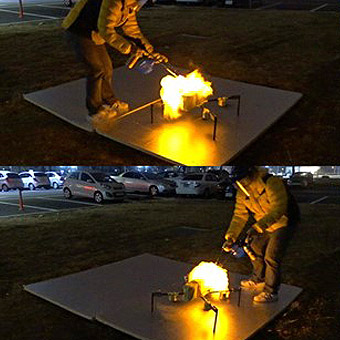
The FAROS can endure the heat of over 1,000° Celsius from butane
gas and ethanol aerosol flames for over one minute. Image: KAIST
Super Scout
Engineers
at South Korea’s Korea Advanced Institute of Science and Technology
have endowed their newest search and rescue drone with a suite of super
powers on par with any found in the mighty Marvel Universe. Designed to
aid firefighters responding to emergencies in high-rise buildings, the
versatile robot flies, sticks to walls, sees in the dark, and is
impervious to fire. Codenamed FAROS (Fireproof Aerial Robot System),
it’s a quadcopter with a 2-D laser scanner, altimeter, and Inertia
Measurement Unit that allows it to land on, cling to, and crawl on the
vertical surface of walls. A thermal imaging camera and image processing
software on board equips FAROS to find people in need of rescue, locate the origin of the fire, inspect
the building for structural damage, and send real-time data to
firefighters below. The primary improvement over the team’s previous
wall-climbing drone is heightened resistance to fire, heat, and smoke.
Researchers said the body is clad in a layer of aramid fibers, which
fends off the effects of flames and protects sensitive internal
mechanical and electronic components in a buffer of thermoelectrically
cooled air. Best Quadcopter with camera
Drone Wars
In a breakthrough pitting one of the newest forms of mechanized combat
against one of the oldest, a Russian arms maker recently unveiled
a new arsenal of UAV-mounted anti-tank weaponry. At this year’s Russian
Armed Forces Robotics conference, state-owned United Instrument
Manufacturing Corporation (UIMC) introduced a multicopter UAV bedecked
with cameras and a shoulder-launched rocket system of the caliber used
against armored vehicles. UAV-launched rockets have many potential
advantages over human-fired weapons – they can get closer to a target
and attack it from any direction. The announcement captured the
attention of defense industry observers, who analyzed a brief Ministry
of Defense video for clues to the system’s capabilities. According to
industry publication IHS Jane’s the
drone is likely fitted with an RPG-26 Aglen anti-tank weapon, which in
conventional use fires 72.5 mm rockets that can pierce 400-mm-thick
armor from a distance of 250 m. The airborne bazooka is part of a new
multicopter attack system for synchronized battlefield surveillance,
artillery spotting, reconnaissance, cargo delivery, and assault. Best Quadcopter with camera
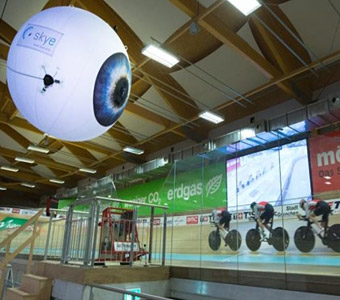
Skye, the aerial blimp-drone is lifted by helium and powered by electrical motors. Image: AEROTAIN
Soft Sell
Few icons of advertising have reached the heights of the venerable
Goodyear Blimp. As the go-to source for aerial broadcasting, the blimp
silently touts the tire brand during America’s most-watched sporting
events. Can drone technology be adapted to harness that same
crowd-friendly star power and bring it within closer proximity to
consumers? That’s what aerospace start-up Aerotain
hopes to learn from Skye, a novel UAV that integrates quadcopter-like
maneuverability into an energy efficient structure that brings the blimp
concept down to human eye level. Conventional UAVs
with exposed rotating blades create a safety hazard in the event of an
unexpected loss of altitude over a crowd. Skye, however, is a
helium-filled sphere 10 ft in diameter – not exactly dainty but soft and
benign enough to pose no threat to spectators below should its
electronics systems fail, developers said. The blimp can be configured
to haul heavy objects like cameras about a sporting event, or be
customized to carry advertising messages. The control and navigation
system can be programmed to spin, roll, or pull off other aerial stunts
requiring a full range of motion.
StarChip Troopers
Beyond doubt, the farthest-out drone concept yet is inspired by the
mind of Stephen Hawking, the celebrity cosmologist, who says it’s time
for Earthlings to reach for the stars in the search for alien life. The
star in question is Alpha Centauri – our nearest neighboring star system
– and Hawking’s interstellar transit plan calls for a light-propelled
nanoprobe that flies 1,000 faster than today’s rockets. Dubbed
Breakthrough Starshot, it’s part of the privately funded Breakthrough Initiatives
program established by Russian Internet investor Yuri Milner to
accelerate the exploration of the known universe. He hopes to focus the
planet’s sharpest minds and deepest pockets on the effort, with guidance
from Hawking and Facebook CEO Mark Zuckerberg. Ultimately reaching the
star system could take tens of billions of dollars and multiple
generations, but Milner said the initial $100 million phase could would
probably trigger the development of a feasible craft launched during his
lifetime. With today’s technology, the 25 trillion-mile trip to Alpha
Centauri would take 30,000 years. The initiative seeks to reduce the
one-way trip to about 20 years. To get there, the team has proposed to
design a full array of space probe equipment that fits on a gram-scale
wafer about the size of a postage stamp. This so-called StarChip would
soar on a set of sails made of an ultra-lightweight metamaterial merely a
few hundred atoms thick. A kilowatt-scale light beaming system based at
high altitude on the Earth’s surface would focus lasers on the
light-sensitive sails to push the craft rapidly to its optimum speed.
Ultimately the team would like to deploy a fleet of several thousand
nanocraft to capture images and data – and quite possibly confirming the
existence of Earth-like planets that could harbor intelligent life. "Earth is a wonderful place, but it might not last forever," Hawking said. “Sooner or later, we must look to the stars.”

No comments:
Post a Comment